New Shock Absorber

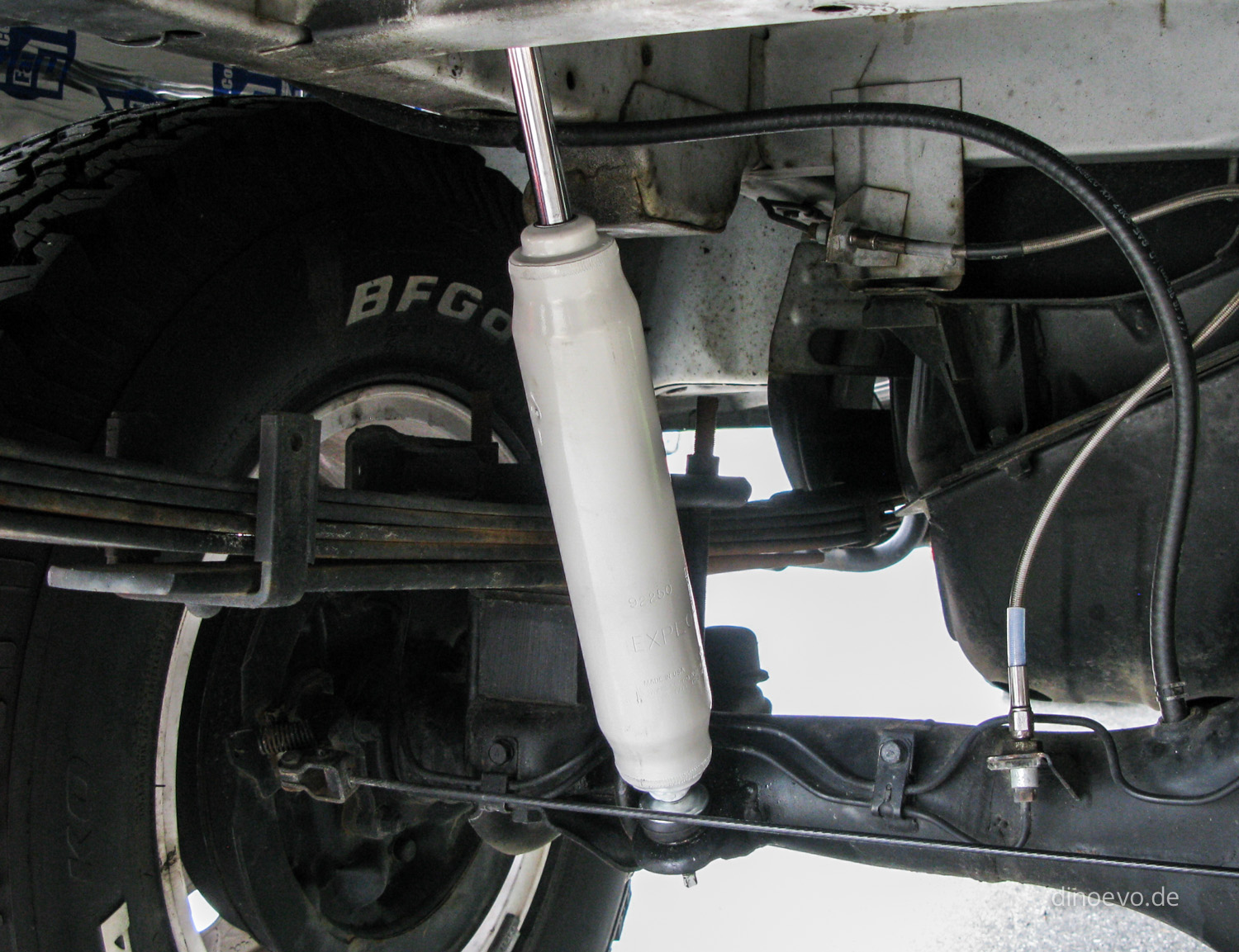
Rear Shock Absorber Last but not least our suspension got new shocks from ProComp. The ES9000 are nitrogen gas charged with a twin tube design and 10 stage velocity sensitive valving. They are a little bit stiffer than the ones we had before, but with DinoEvo fully loaded on our trip they are just right. I also had to change the stock rubber bushings to Polyurethane for durability.

Amp Hour Meter

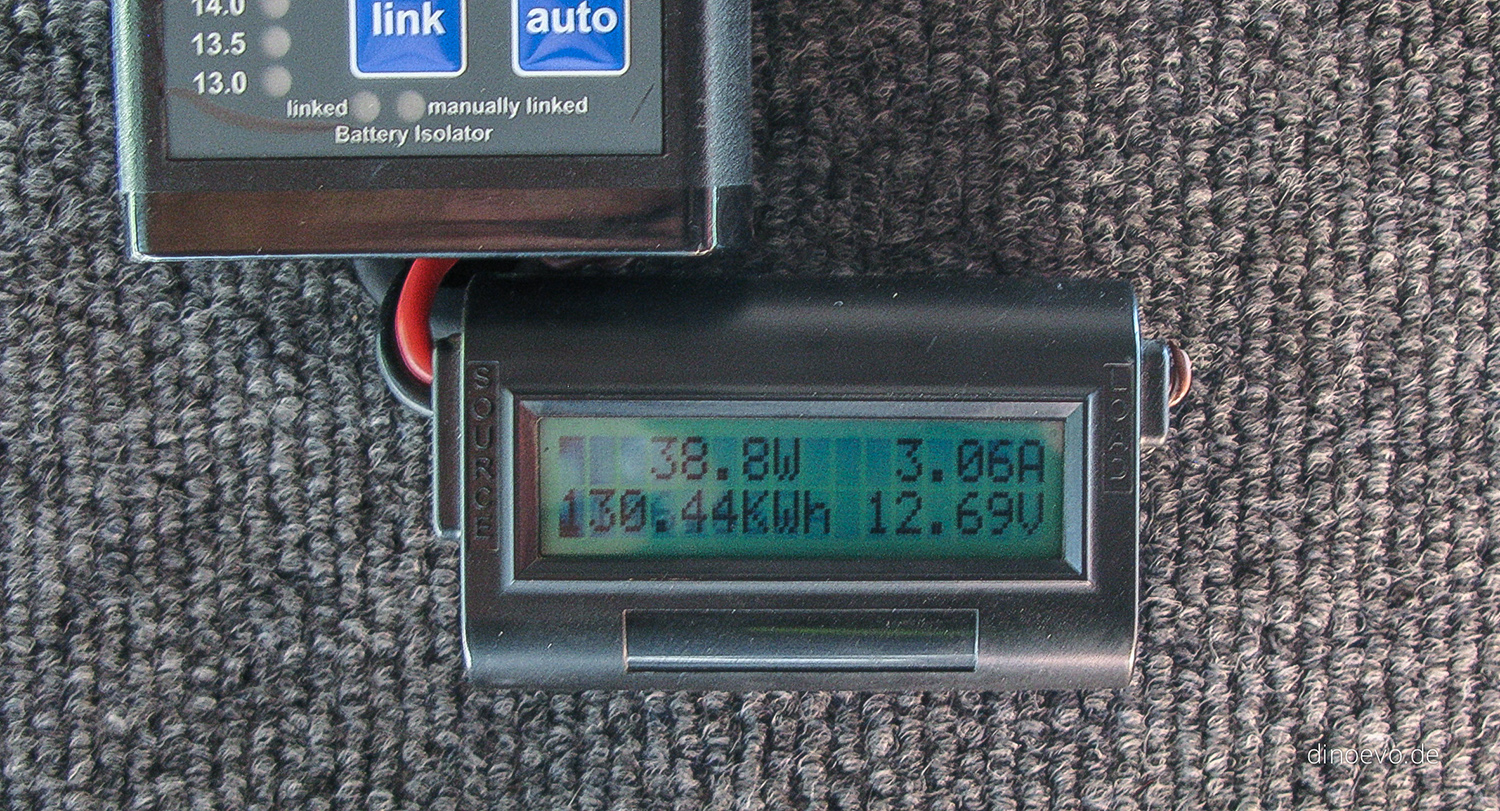
img_0941_0 To get more information about how our auxiliary battery is doing, we installed a DOC Wattson RV & Marine Battery Monitor and a Current Shunt Resistor. The monitor measures Amp-Hours, Kilo Watt-Hours, Amps, Watts, Peak Amps & minimum Voltage as well as Voltage.

The Amp hour (Ah) and Kilo Watt hour (KWh) measurements are much more accurate “fuel gages” than voltage measurements which depend on many other factors. Kilo Watt Hours are better than Amp hours because the effects of voltage change are included in calculating the actual energy delivered to the load. Ah and KWh are much more accurate than the voltage based RV or marine “Battery Indicator” measurements.

Peak Amps and minimum volts measurements show you even short duration load events and help you troubleshoot hard to find electrical problems. Statistics are reset when power is removed.

Our electrical system including solar and dual batteries is now complete and should give use enough power to stay independently when we are on the road.

Air Compressor

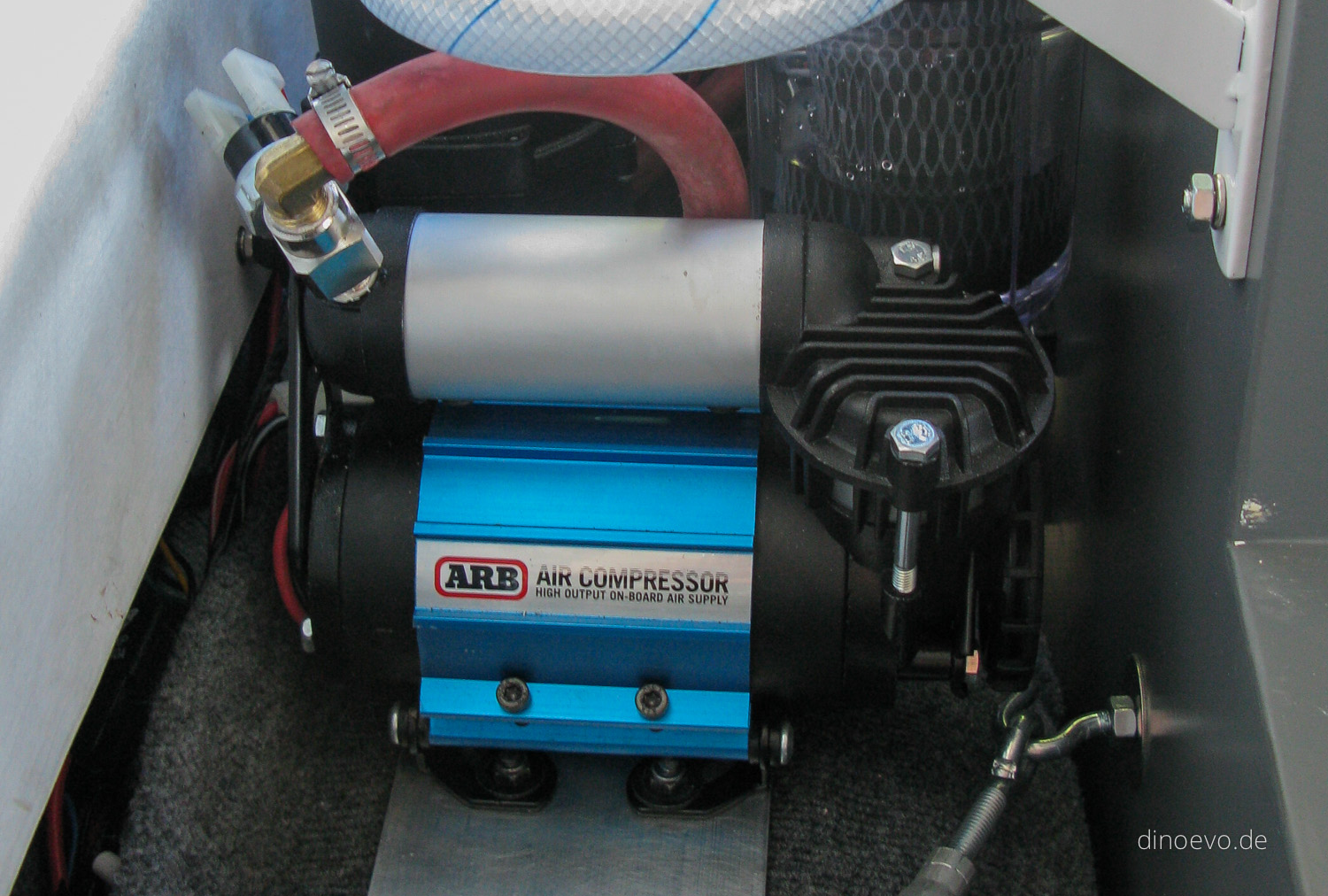
img_0044 Having a reliable source for compressed air was a necessary topic we need to solve. First, I air-down the tires when we go on 4×4 excursions for several reasons: Larger tire contact patch improves traction, way better ride quality over bumpy, rocky surfaces as well as washboards and in the end less risk of punctures from sharp objects. Second, fixing a flat tire doesn’t work without an compressor. Third, blowing out dust or pumping up a air-mattress is just so much easier.

Ultimately a system with an air tank would be the best, but our tires are not overly huge as well as time for airing them up is not an issue on a long road-trip. Also using air-tools is not necessary either.

In the end I went with an ARB CKMA12 high output air compressor due it’s very compact size and power. If I decide to add differential lockers in the future, this compressor makes it easier as well as all the necessary wiring is included.

As for the installation location I chose the area right behind the fresh water system with a hose and a quick connect coming out below the water faucet in the back. To round up the equipment I also bought the ARB Air Compressor Pump-up Kit. It contains the right length of a quality hose with the right connectors as well as everything you need to fill up your tires and other stuff.

Fresh Water System

img_0109 At our last visit of the Abenteuer & Allrad Overland Expo in Germany we found some interesting ways of how other travellers did their fresh water system. I adapted a few of these ideas and came up with the following:

Tank:
Most of the more advanced systems had custom made tanks which I didn’t like much. First, they are harder to clean, way more expensive and sometimes tricky to fill. In our previous camper we were quite happy with a couple of military water cans. They are light-weight, easy to store and clean as well as they can be filled up almost everywhere without moving your car to the nearest tap.
This time though I wanted to hock them up to a proper pressurized water system with a pump, filters and a faucet. To do so I modified the lid of the water cans and attached a pickup-hose with a quick-connect to it. Under our sleeping platform is enough space for two 20l water canister which slide in very easy from the back. When one can is empty, I just swap it with the full can from behind.

Pump/Filter:
As a pump I got a ShurFlo Aqua King Junior 2.0, which draws not much power, has enough flow-rate and can dry run without getting damaged.
One main goal of our fresh water system was to produce pure drinking water. We wanted to be able to fill up our canisters at any questionable tab or fountain and not getting sick from it.
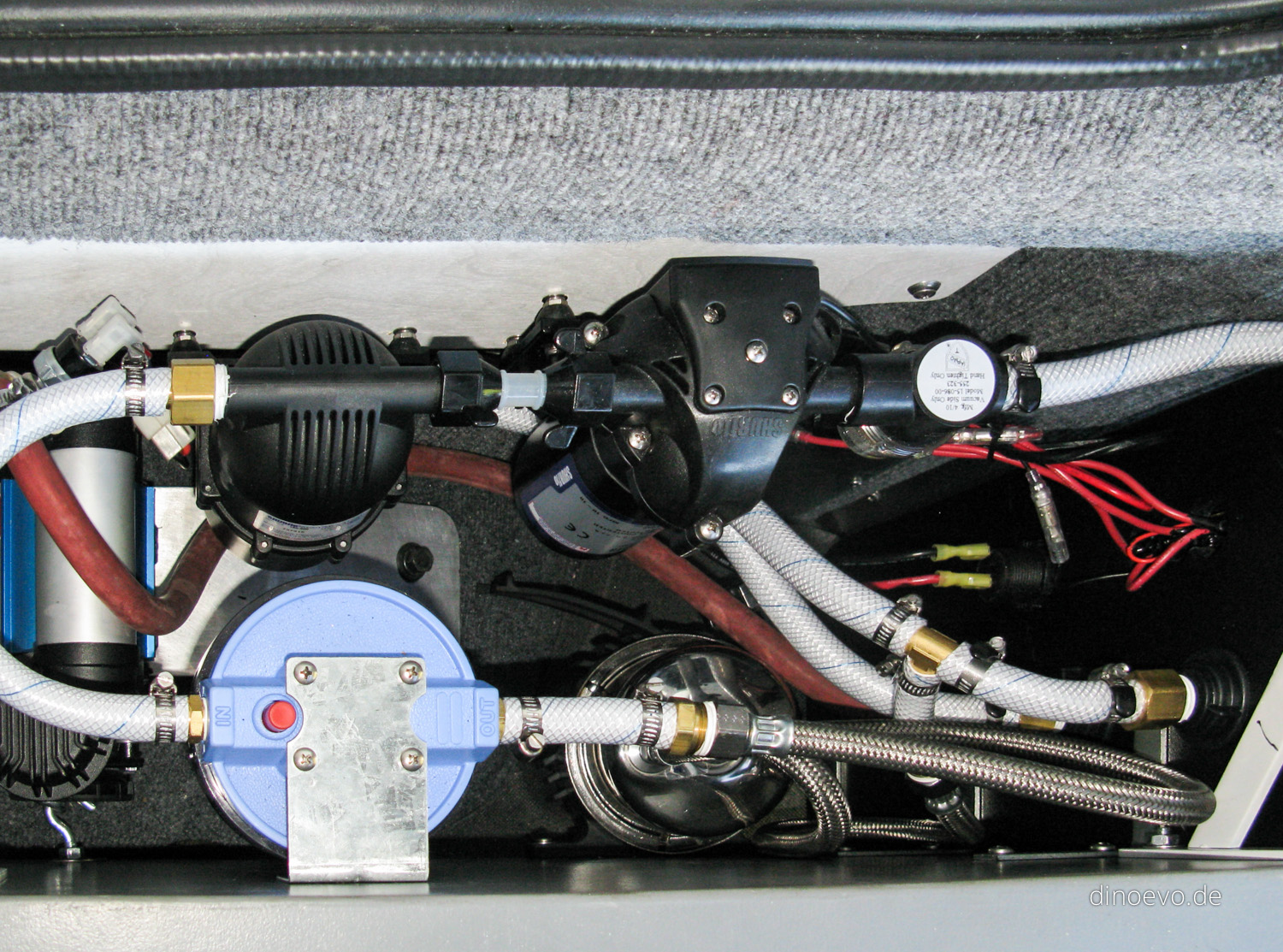
For this reason, I use a four stage treatment. First, the pump picks up the water from the canister and sucks it through a strainer with a stainless mesh to keep debris and other bigger particles out. After that it goes through the pump into an accumulator tank, which extends pressure switch-controlled pump life by reducing pump on-off pulsation. From there it goes into standard marine water filter housing with a 5 Micron filter cartridge. Constructed of a carbon impregnated cellulose media, these dual-purpose cartridge filters out fine sediment particles and reduce unwanted taste, odor and chlorine taste from the water. Also this pretty cheap filter element extents the lifespan of the main filter.
From here it goes into the main water filter which is a Seagull IV X-2KB. This filter is the best of the best and it is used extensively in the high-end expedition- and marine-industry. It is not cheap, but our health is us worth every penny.

All Seagull IV purification systems are independently certified to meet EPA guide standard protocol for microbiological purifiers against bacteria, cysts and viruses. Plus, Seagull IV systems excel at removing chemical and aesthetic contaminants including herbicides, pesticides, chlorine and foul tastes, odors and colors, for great tasting water on demand.

The smaller Seagull IV X-1F would have been enough for our task as well, but I got a good deal on the larger system so I went with that instead.
If we are really in doubt about the water quality we also add a little bit of Microdyn (or bleach) to be really on the safe side.

Faucet:
Finding the right faucet with an hot/cold outlet took ages as most of them are just the standard low pressure faucet you see in RV next to a sink or are simply way to big. I wanted something small with a quick connect, so I can also plugin a shower hose. After more research I found a company in the Stats with an interesting product called “Hot & Cold Spray-Port™”. Exactly what I was looking for beside the white plastic box, which was easy to remove. I hocked it up to the hot-water tank as well as the cold water line and it was ready to go.
For the actual outlet I also chose a great product from the creators of the faucet. A flexible, durable food-grade plastic spout. It plugs in right to the quick connector of the faucet and can be bent in any direction. As for our shower, I used the same quick connector on a long hose as well as the smallest RV shower head I could find.

For a better understanding how everything is connected together, here is a diagram of DinoEvo’s fresh water system:
Diagram Fresh Water System

All in all it turned out to work great. It is just such a luxury thing to have instant warm water for a quick shower or even to wash greasy dishes. In the future I probably going to add a thermostat-valve before the hot-water-outlet, because the water coming from the Elgena is boiling and I don’t want to burn myself if I’m not careful. A small downside of this system is obviously you do everything with pure drinking water, but with such a long lasting filter and limited space it is a compromise I can live with.

In terms of location, the entire system fits nicely in the opening over the driver side rear wheel well and can be accessed through a removable hatch.

Thank You!

After 1.5 years, hundreds of hours, many many late nights and a lot of scratching heads and bloody knuckles, I really want to say thank you to a few of my friends who helped out on this project. Without them this van wouldn’t be as awesome and tricked out as it is.

My special thanks goes to Jay who is a great mentor and the biggest helping hand on this project. Mr. Electric showed off all his skills and his profession in the boating industry made DinoEvo almost an amphibious vehicle :)

Thank you Rich for your wood working skills, ideas and the time I could use your shop. The cabinet turned out fantastic.

Thanks to Butch the owner of CVI for his help, knowledge and the time I could use his shop.

Thanks to my friend David for his hospitality, tools and all his great help to pull off our road trip as well as being the supporting trip member back home :)

Thank you Jesse for sharing your knowledge and ideas on this project.

There are many other people out there I had contact with to bounce off ideas and ask questions via email. Thanks for your effort and replies. Also thank you to all the members of the different forums around the globe who took their time to reply to my questions.

THANK YOU

Sleeping Platform

Lets talk about the most complex single project during our camper conversion. The main cabinet. It took about 6 month from the initial ideas to the stage when we finally installed it. A big part of the work was done by a friend with a lot of passion and wood working skills. Initially we came up with a long list of requirements.

  • Lightweight, but durable
  • Accommodate a 10l Scepter fuel can for our Diesel coolant heater.
  • Space for at least 40-60l of fresh water
  • Cutting area and a storage for all our kitchen supplies
  • Accommodate a multifuel stove (like a MSR DragonFly)
  • Storage for our Engel fridge
  • Space for a proper fresh water system (pump, filters) as well as an air compressor
  • Cabinet design need to be free standing and not screwed to the vehicle body
  • Accommodate a 200cm / 78inch long bed, but leave enough space to sit on the engine hump
  • Area for two to four large plastic containers

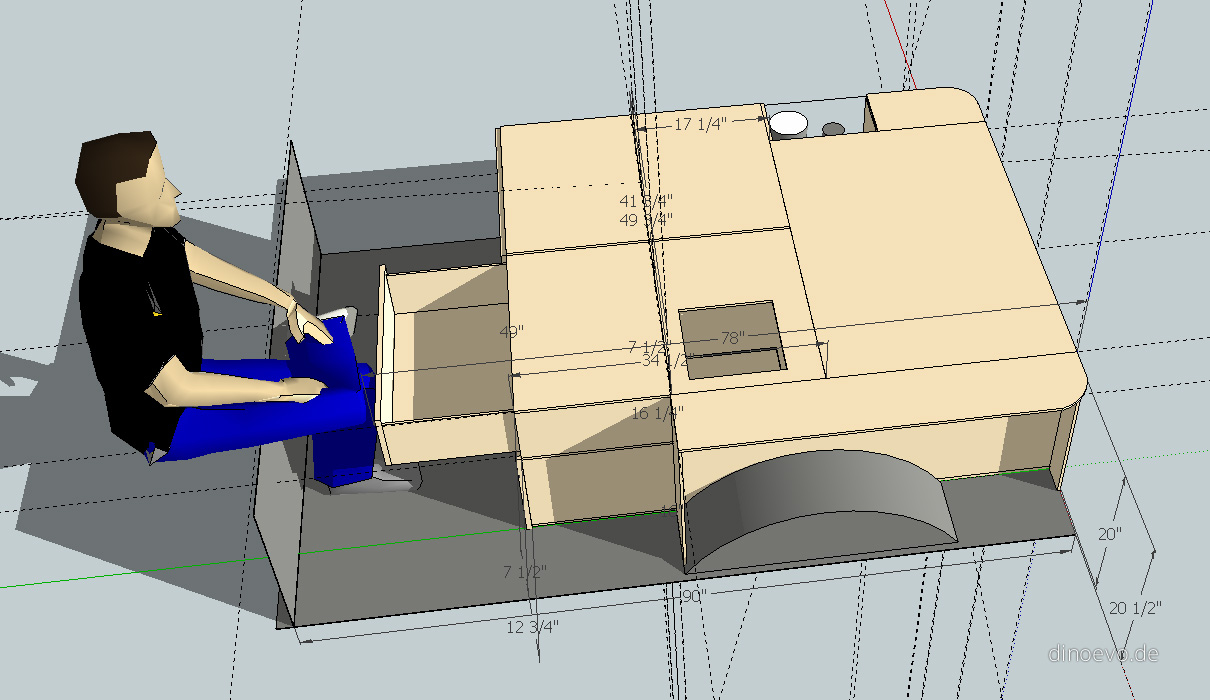
After that we approached the design from many different angles made one drawing after another one and bounced several ideas around. All of them had pros and cons but in the end we settled on one design with the most advantages and most economical space usage.
cabinet_drawing1
Front:
The idea was to raise the platform as high as possible, but still be able to sleep comfortable. On the other hand there need to be enough space between the cabinet and the front driver/passenger seat to have some kind of area you can sit and live inside when the weather is not good. To do that the cabinet had to have an extendable bed, otherwise the bed would be not long enough. The solution was two large storage drawers with strong sliders in the front.

img_0228
Rear:
Another large part of the cabinet is the area with our fridge. Having a proper fridge (and I’m not talking about a cheap 12v cool box) makes all the difference on a long trip like that. So we knew we are going to use it several times a day, which means it has to be very accessible. Solution: a heavy duty, full-extension slider in the back. Underneath that another small sliding table.
Right next to the fridge there is one 24″ and two 42″ long storage drawers. The bottom drawer is our cooking area. In the front is a MSR Dragonfly multi-fuel stove including a 1l fuel can. The stove burns pretty much every fuel and is very reliable. It also can be removed when we want to go camping with a tent. The lid of the bottom drawer is out of a butcher block material and works great as a cutting area.
Beside the large drawers there is a long space for one 10l Diesel can as well as two 20l military Scepter water cans.

After our first packing session we were really amazed how much stuff you can fit in the cabinet.

img_0241

Mattress:
We bought two different coloured Sunbrella fabrics from outdoorfabrics.com and gave it to a foam shop which made the covers as well as provided the (puuuhhh expensive) high-density foam pieces. With the main foam piece set in place as well the two separate pieces we are pretty flexible in setting up our bed. Either the entire bed is open or just one side. So one person can still sleep when another person sits on the engine hump using the area as a table.

Details:
All slides are heavy-duty and rated for 200lbs (90kg) each set. One of the heaviest parts on the cabinet, but we didn’t want to compromise in durability.

We used regular climbing rope as a handles for the rear drawers which works really well, is lightweight as well as a good bump stop against the rear hatch door.

All drawers are secured with stainless sliding pins from a marine shop. I also made metal inserts to prevent any worn out pin holes.

On the passenger side we built another box over the wheel arch to store bigger items as well as attached an axe and saw with a couple Quick Fist rubber clamps. On the opposite side is a compartment for portable water filters, water pump and an ARB air-compressor (more about that in a separate post)

As you see in the photos below, all edges are protected with Marple hardwood, wile the rest of the cabinet is half inch birch plywood. The drawer front face is made out of clear coated solid Marple hardwood as well to give it extra protection and a nice touch to the cabinet overall.

It took quite a long time to finish the cabinet, but in the end everything worked out well and we are very happy with the outcome. Thanks to my friend for all the time and effort he put into this project. Without him this cabinet wouldn’t be as nice as it is.

Pages: 1 2 3 4 5 ...14